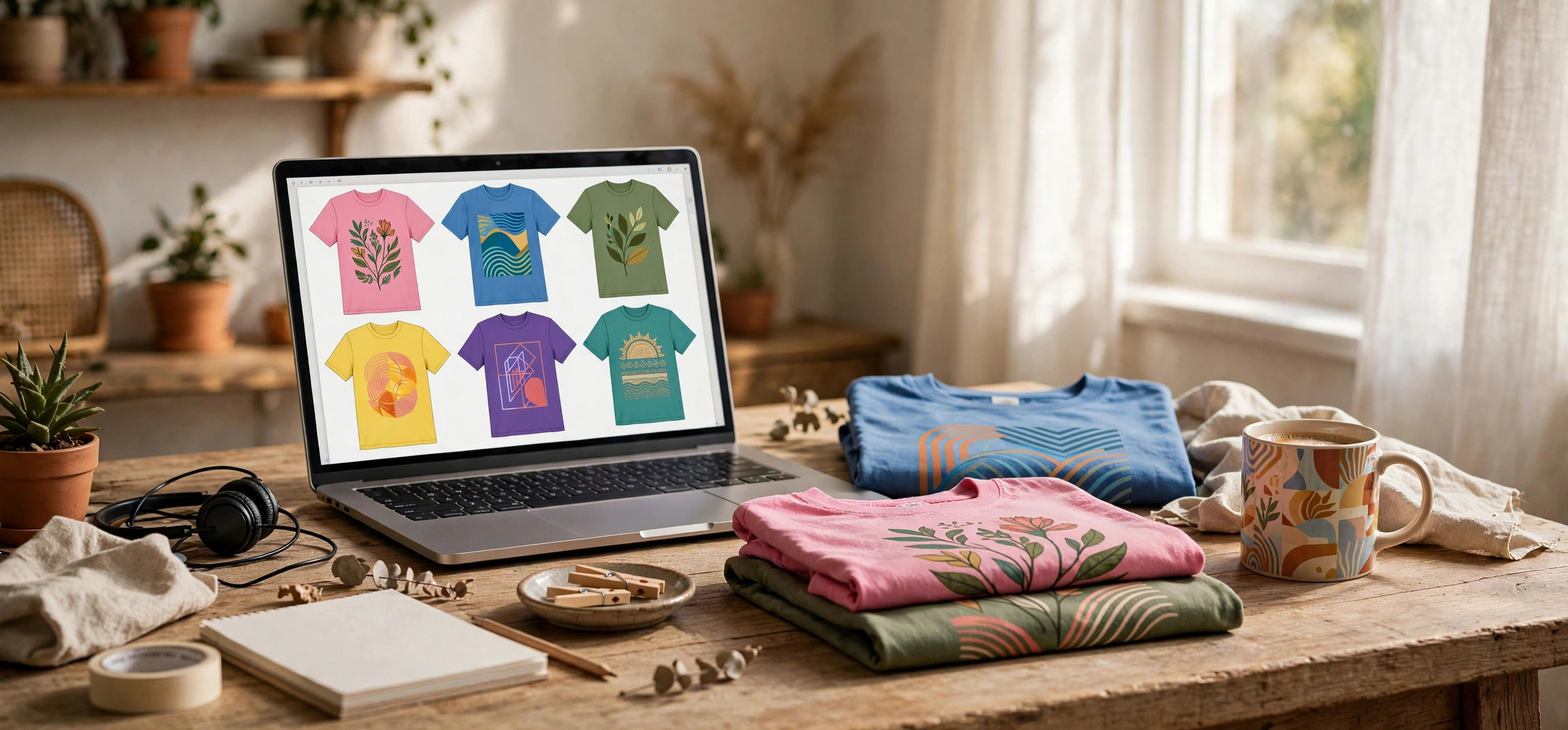

How to start a print on demand business with no money is a question with a genuinely possible answer — POD is one of the few online businesses with a real zero-investment entry point. You create designs; a print-on-demand company prints them on t-shirts, mugs, hoodies, and posters only when a customer orders, then handles shipping and customer service. No inventory, no printer, no packing boxes. Your only investment is time: designing, listing, and promoting. This guide covers the free platforms, free tools, exact steps, and — honestly — what it really costs and earns.
In This Guide
- How Print on Demand Actually Works
- The Truly Free Route: Platforms and Tools That Cost Nothing
- How to Start a Print on Demand Business With No Money: 7 Steps
- Print-on-Demand Platforms Compared
- Realistic Earnings and Honest Costs
- 6 Mistakes That Kill Beginner POD Stores
- Frequently Asked Questions
- Final Thoughts
How Print on Demand Actually Works
In traditional merchandising, you would design a t-shirt, order 500 units, store them, and hope they sell. Print on demand flips that: you upload a design, choose products, set your price — and when a customer buys, the platform prints that single item, ships it to the buyer, and pays you the margin above its base cost. No inventory, no upfront printing bill, no warehouse.
Your profit per item is usually a few dollars — modest per sale, which is why catalogue volume and good design selection matter more than any single “winning” product.
Two flavours exist. Marketplace POD (Redbubble, Spring, Zazzle, Merch by Amazon) gives you a storefront on their marketplace — they bring traffic, you bring designs, you earn per sale. Integrated POD (Printful, Printify with your own Shopify/Etsy store) offers more control and branding but requires you to drive traffic yourself. For a zero-money start, marketplaces win: free to join, free to list, buyers already searching.
The Truly Free Route: Platforms and Tools That Cost Nothing
“No money” means no spending beyond the device and internet access you already have. Here is the genuinely free stack:
Free marketplace platforms
- Redbubble — free to join and upload; you set your markup above base price on dozens of products. The easiest starting point worldwide (see Redbubble’s official site).
- Spring (formerly Teespring) — free creator storefronts; you design, they produce and fulfil. Good if you also promote on social media.
- Zazzle — free designer accounts; enormous catalogue from apparel to stationery; you set royalty percentages within their range.
- Merch by Amazon — Amazon’s POD program; free to apply, though acceptance is not instant and new accounts face design-upload tier limits.
Free design tools
- Canva (free plan) — enough for clean text-based designs, which dominate POD bestseller lists. Keep compositions original; avoid stock elements in ways their licence restricts for merchandise.
- Photopea — a free browser-based Photoshop-like editor, useful for preparing print-ready files.
- Your phone — hand-lettering and doodles drawn in a free app can become designs; some successful POD niches are deliberately lo-fi.
What about India-specific options?
Indian sellers should also know Blinkstore and Qikink — India-based POD services that print and ship domestically, useful once you outgrow marketplaces and want your own store. For a free start, the global marketplaces above remain simplest.

How to Start a Print on Demand Business With No Money: 7 Steps
Step 1: Pick one narrow niche
“Funny t-shirts” is not a niche. “Funny t-shirts for Indian dog parents” or “retro travel posters for Goa lovers” are. Narrow niches mean less competition, clearer buyers, and designs that feel made-for-them — which converts browsers into buyers. Spend a day browsing Redbubble and Amazon results in candidate niches before committing.
Step 2: Research what actually sells
Search your niche on the marketplaces and sort by bestsellers. Note recurring themes, colour palettes, and text styles — you are learning the visual language buyers already respond to, not copying. Google Trends can confirm whether niche interest is stable or fading.
Step 3: Create 20–30 simple designs with free tools
Volume beats perfection at the start. Text-based designs with clean typography outsell complex illustrations for most beginners and are far faster to make in Canva. Build 20–30 designs before expecting traction — a three-design store looks abandoned to buyers and search algorithms alike.
Step 4: Open free storefronts on two marketplaces
Start with Redbubble plus one more (Spring or Zazzle). Uploading the same designs to multiple marketplaces multiplies discovery at zero extra cost. Fill out every profile field — marketplace search rewards complete listings.
Step 5: Write titles, tags, and descriptions for search
This unglamorous work separates earners from upload-and-pray sellers. Use the exact words buyers type: “funny dog dad t-shirt,” not “canine paternal humour apparel.” Include niche, occasion (birthday gift, Diwali gift), and audience in your tags. Marketplace SEO is free traffic that compounds as your catalogue grows.
Step 6: Promote for free where your buyers hang out
Post designs on Instagram, Pinterest, and relevant Reddit or Facebook communities — as genuinely useful or entertaining content, not spam. Pinterest is a quiet POD powerhouse because pins act as permanent search listings; one viral pin can drive sales for months. Never pay for ads until a design proves itself organically.
Step 7: Double down on what sells, cut the rest
After 60–90 days, check which designs got views and sales. Make variations of winners (different colours, related phrases, matching mug/poster versions). Ignore or improve the designs nobody clicked. POD is a portfolio game: most designs earn little, a few earn steadily, and your job is to keep feeding the winners.
Print-on-Demand Platforms Compared
| Platform | Cost to start | You earn | Traffic source | Best for |
|---|---|---|---|---|
| Redbubble | Free | Your markup above base price | Marketplace search | Beginners; fastest free start |
| Spring | Free | Your set profit per product | Your own audience + marketplace | Creators with social followings |
| Zazzle | Free | Royalty % you set | Marketplace search | Huge product variety |
| Merch by Amazon | Free (application) | Royalty per sale | Amazon search | Access to Amazon buyers; slow approval |
| Printful / Printify | Free plans (store costs extra) | Retail minus base cost | Your own store traffic | Branded stores; step two, not step one |
| Blinkstore / Qikink | Free to join | Margin per sale | Your own store traffic | India-based fulfilment later on |
If this model appeals to you, also explore our beginner’s guide to selling digital products online — digital downloads share POD’s zero-inventory logic with even higher margins.
Realistic Earnings and Honest Costs
Most beginners earn little or nothing in the first three months — POD income follows a catalogue-and-compounding curve. Sellers who upload a handful of designs, never optimise listings, and never promote typically earn pocket change. Those who build catalogues of hundreds of well-targeted designs can build genuine semi-passive income — but that takes many months of consistent work.
Per-sale margins are modest by design: a few dollars on a t-shirt, less on stickers, more on hoodies. That is why successful sellers think in hundreds of listings, not dozens. The free route costs time, not money — and the moment you “invest” (ads, Shopify, a designer), you need sales to justify it. Keep the free phase genuinely free until designs prove themselves.
POD is competitive precisely because entry is free. Your edge is not the model — it is niche selection, design quality, and listing SEO. Treat it like a real small business from day one, and the zero-money start becomes an advantage: you learn the market before spending a rupee. For a related handmade route, see how to sell handmade crafts online in India.
6 Mistakes That Kill Beginner POD Stores
- Trademark infringement. Brand names, celebrity likenesses, movie quotes, or team logos get designs removed and accounts banned — sometimes permanently. When in doubt, leave it out.
- Uploading five designs and waiting. POD rewards catalogue depth; a tiny store has almost no discovery surface. Commit to dozens of listings before judging results.
- Ignoring tags and titles. The best design earns nothing if nobody finds it. Marketplace SEO is half the business.
- Designing for yourself, not a buyer. Your taste is not the market — design for a specific audience’s identity, humour, or profession.
- Paying for ads too early. Ads amplify; they do not fix a design nobody wants. Validate with organic traffic first.
- Quitting at day 30. POD compounds slowly; sellers who persist past six months of consistent uploads are in a different universe from month-one quitters.
For the broader picture of building an audience that buys what you make, our affiliate marketing beginner’s guide for India covers promotion skills that transfer directly to POD.
Frequently Asked Questions
Can I really start print on demand with zero money?
Yes — Redbubble, Spring, and Zazzle are free to join and list on, and Canva’s free plan plus Photopea cost nothing. Your investment is time. Spend money only later (your own store, ads) and only after designs prove themselves.
Do I need to be a designer?
No. Text-based typography designs — clever phrases in clean fonts — are among POD’s consistent sellers and require no illustration skill. Free tools and practice close the gap quickly; many successful sellers started with zero design background.
How long until I make my first sale?
Some sellers see a first sale within weeks; others take months. Catalogue size, niche choice, and listing SEO matter most. A realistic expectation for a consistent beginner: first sales within 1–3 months, not days.
Which is better: Redbubble or Merch by Amazon?
Redbubble is faster — instant uploads, no approval wait. Merch by Amazon offers Amazon’s enormous buyer base but needs application approval and limits new accounts’ uploads initially. Many sellers eventually use both.
Can I do print on demand from India?
Absolutely. Global marketplaces accept Indian sellers and handle international fulfilment, with payouts typically arriving via bank transfer or PayPal. Blinkstore and Qikink add domestic printing and shipping when you are ready for your own store.
Is print on demand still profitable in 2026?
It is profitable for sellers who treat it as a real business — niche research, good design, listing SEO, and catalogue depth. It is not profitable as a get-rich-quick scheme. Competition is real, margins per item are modest, and success compounds over months, not days.
Final Thoughts
Knowing how to start a print on demand business with no money is the easy part — the platforms and tools above genuinely cost nothing. The harder part is the work nobody can do for you: picking a sharp niche, producing dozens of designs, writing findable listings, and persisting past the quiet first months. Do that, avoid trademark landmines, never spend before designs prove themselves — and you will own a real asset: a catalogue that keeps selling while you sleep.